The delivery of artwork from artist to the client's wall has certainly changed, thanks to the Internet. While the experience of going to a gallery and seeing the work before you purchase it is part of the enjoyment of buying art, we are witnessing an explosion in choice online.
If you're willing to forgo the person-to-person experience and trust what you see on a computer screen, you can buy fine art ranging from classic posters, reproductions of the old masters, photographic images and even original sculpture and paintings from contemporary artists. A number of companies have evolved to serve this market, including Fine Art America, Imagekind and Saatchi Online. Most of the time, the risk of buying art online is mitigated by very good return policies.
As a photographer, I want to create compelling images, but don't want the hassle and expense of colour management, printing and shipping worldwide. That's why I've revamped my photographic prints website to include simple-to-follow links to print fulfillment sites like Fine Art America and Imagekind. Not only will they supply you with canvasses and archival paper prints in a wide variety of sizes, but they will frame them, if you wish, using materials of your choosing. Fine Art America also offers greeting cards, made from any image in my galleries.
For local buyers who prefer to deal with me directly, or prefer a hand-signed print, I work with a local facility where I can monitor print quality. Ordering and payment is still handled online, though, via the secure e-commerce feature on my Photoshelter website.
Save some money and time (unless you love going to galleries, of course). Try exploring the vast array of fine art options online!
Showing posts with label photographic. Show all posts
Showing posts with label photographic. Show all posts
Wednesday, 18 July 2012

Wednesday, 30 March 2011
How Not to Use Studio Strobes
It’s obvious that some overseas companies rely on (bad) software that literally translates every word from their language into the closest English word, but, of course, completely out of context. It’s a good thing that this particular product I purchased online was simple enough that I didn’t need instructions, because three years later I’m still trying to decrypt the piece of paper that came with it.
It’s actually quite amusing to read, and it amazes me that they wrote so much about how to use a simple, slave-only strobe that screws into a light bulb socket. Here are some snippets, and my interpretations:
“Thank you to choose the series electronics to dodge the lamp, it is that the ideal light source taken a photograph is dodged in the various rooms that this series electronics dodges the lamp.”
INTERPRETATION: Not sure why you’d want to dodge the lamp, but they’re deeply grateful that I purchased it.
“It still possesses advanced the gleaming remote sensing device, can receive the pulse and gleams at the distant range place, thus synchronously gleaming with the signal voluntarily, the lamp colour temperature ideal is dodged to this series, and it is big to shine the angle, and ability and various soft light umbrellas and reflection of light umbrella cooperate to use in the reality is applied, but effect is better.”
INTERPRETATION: OK, so apart from being a hellishly long sentence, I get the idea that it gleams (handy for a strobe light), remotely triggers without a struggle, has a dodged (aha – matched maybe?!!) colour temperature (to what, we’re not sure) and gleams nicely (in reality) with a bounce umbrella, or not.
“The item is paid attention to:
1. Long-term whens disuse, the dump, and at a distance from one period to the electronics dodges the lamp to be charged to try to dodge several times, and can lengthen the electronics dodging life span. Leave, and is not affected with damp to be heated.”
INTERPRETATION: Methinks it can hold its charge for a long time after it’s unplugged, and is ready to be fired (oh-oh, is that what dodged means?) when screwed back into the socket. And, whatever you do, remember never to heat the damp.
It continues:
“2. Not dismantling the electronics, if the sick requests (company name withheld) repair section or this company to be engaged by special arrangement the maintenance ministry and repairs at will.”
INTERPRETATION: They have a Maintenance Ministry in their country, so if you try to take apart your sick (strobe), a school bus will pull up to your door and several heavily armed Ministry auditors, accountants and actuarials will kick your door down and throw you to the floor.
If there are any overseas manufacturers reading this, I would like them to know that in addition to being a wonderful stock and fine art photographer, I’m also a technical writer and a very good proofreader. So, please get in touch at my other web site: www.taskpartner.ca
It’s actually quite amusing to read, and it amazes me that they wrote so much about how to use a simple, slave-only strobe that screws into a light bulb socket. Here are some snippets, and my interpretations:
“Thank you to choose the series electronics to dodge the lamp, it is that the ideal light source taken a photograph is dodged in the various rooms that this series electronics dodges the lamp.”
INTERPRETATION: Not sure why you’d want to dodge the lamp, but they’re deeply grateful that I purchased it.
“It still possesses advanced the gleaming remote sensing device, can receive the pulse and gleams at the distant range place, thus synchronously gleaming with the signal voluntarily, the lamp colour temperature ideal is dodged to this series, and it is big to shine the angle, and ability and various soft light umbrellas and reflection of light umbrella cooperate to use in the reality is applied, but effect is better.”
INTERPRETATION: OK, so apart from being a hellishly long sentence, I get the idea that it gleams (handy for a strobe light), remotely triggers without a struggle, has a dodged (aha – matched maybe?!!) colour temperature (to what, we’re not sure) and gleams nicely (in reality) with a bounce umbrella, or not.
“The item is paid attention to:
1. Long-term whens disuse, the dump, and at a distance from one period to the electronics dodges the lamp to be charged to try to dodge several times, and can lengthen the electronics dodging life span. Leave, and is not affected with damp to be heated.”
INTERPRETATION: Methinks it can hold its charge for a long time after it’s unplugged, and is ready to be fired (oh-oh, is that what dodged means?) when screwed back into the socket. And, whatever you do, remember never to heat the damp.
It continues:
“2. Not dismantling the electronics, if the sick requests (company name withheld) repair section or this company to be engaged by special arrangement the maintenance ministry and repairs at will.”
INTERPRETATION: They have a Maintenance Ministry in their country, so if you try to take apart your sick (strobe), a school bus will pull up to your door and several heavily armed Ministry auditors, accountants and actuarials will kick your door down and throw you to the floor.
If there are any overseas manufacturers reading this, I would like them to know that in addition to being a wonderful stock and fine art photographer, I’m also a technical writer and a very good proofreader. So, please get in touch at my other web site: www.taskpartner.ca
Achtung! Dangerous Old Films
The images in this gallery were taken by my great-great uncle, Heinrich Schildknecht, an Austrian "alpine" photographer.
The 4"x5.75" negatives were given to me by his grandson when I met him in Europe several years ago. It's difficult to date them because the date that the photographer wrote on the envelope looks like it could either be 1919 or 1929. Now that I have a flatbed scanner with a transparency unit, I thought it was time to preserve them.
I remember asking his grandson whether or not he had his grandfather's complete collection of negatives. He replied "No, my grandfather's studio burned down". I'm not surprised.
To the best of my knowledge, the items he gave me are made with a cellulose nitrate base. Most articles you read about this type of film give dire warnings that they are extremely flammable. The typical advice is to copy them, then dispose of them properly.
Two of the many signs that films are made of cellulose nitrate are the tendency to curl and turn amber as they age. Have a look at the picture of my negs. They definitely exhibit these characteristics. The ones that curl the most seem to have a thicker base, while the flat ones are almost as thin as paper.
In some cases, the experts warn, the emulsion becomes sticky and gives off a toxic gas. Luckily, mine do not have this problem, although the emulsion is flaking in places.
There are several ways to test these films to determine whether or not they are cellulose nitrate, as outlined in this excellent article: http://bit.ly/aAKaQi. I decided to try the burn test with a strip of each of the thin and thick bases.
With the fire department on speed dial, I headed outside in the snow, far from the house and lit 'em up. Yup -the thick base burned very quickly and crackled a bit like a sparkler. The thin base was a bit more sluggish, but also burned fairly quickly.
The safe assumption is that these are cellulose nitrate bases, so I'll be doing the right thing and disposing after copying. I may even wait for a fireworks celebration and have my own backyard spectacle. If a reader more knowledgeable than I has more insight into these negs, I would appreciate a comment.
Amazingly, from the timeline in this document (http://bit.ly/d4ysrt), Kodak introduced an acetate safety film in 1908, but continued to produce cellulose nitrates until 1951. I can't speak for other manufacturers, though, but this seems to defy common sense!
The 4"x5.75" negatives were given to me by his grandson when I met him in Europe several years ago. It's difficult to date them because the date that the photographer wrote on the envelope looks like it could either be 1919 or 1929. Now that I have a flatbed scanner with a transparency unit, I thought it was time to preserve them.
I remember asking his grandson whether or not he had his grandfather's complete collection of negatives. He replied "No, my grandfather's studio burned down". I'm not surprised.
To the best of my knowledge, the items he gave me are made with a cellulose nitrate base. Most articles you read about this type of film give dire warnings that they are extremely flammable. The typical advice is to copy them, then dispose of them properly.
Two of the many signs that films are made of cellulose nitrate are the tendency to curl and turn amber as they age. Have a look at the picture of my negs. They definitely exhibit these characteristics.
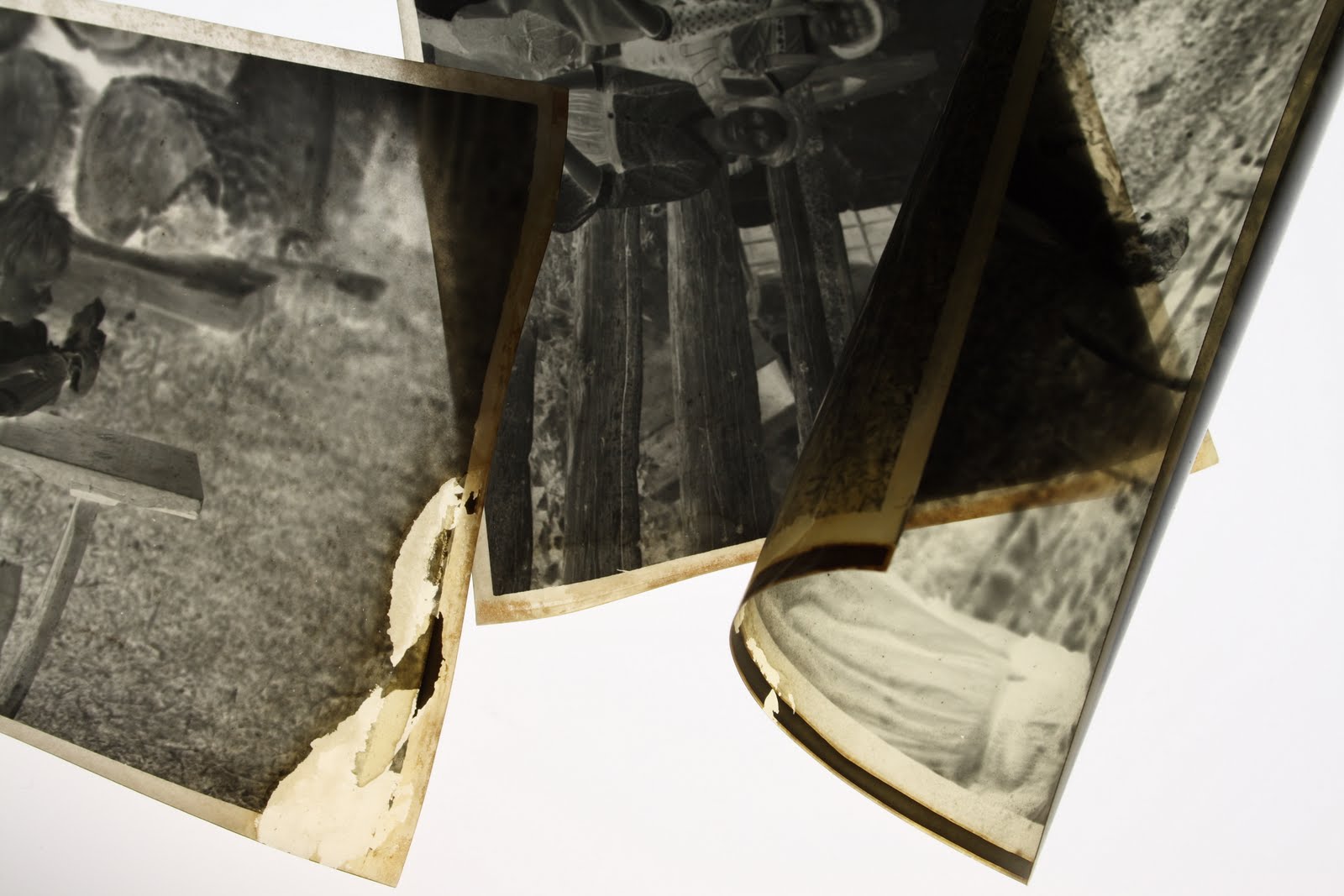 The ones that curl the most seem to have a thicker base, while the flat ones are almost as thin as paper.
In some cases, the experts warn, the emulsion becomes sticky and gives off a toxic gas. Luckily, mine do not have this problem, although the emulsion is flaking in places.
There are several ways to test these films to determine whether or not they are cellulose nitrate, as outlined in this excellent article: http://bit.ly/aAKaQi. I decided to try the burn test with a strip of each of the thin and thick bases.
With the fire department on speed dial, I headed outside in the snow, far from the house and lit 'em up. Yup -the thick base burned very quickly and crackled a bit like a sparkler. The thin base was a bit more sluggish, but also burned fairly quickly.
The safe assumption is that these are cellulose nitrate bases, so I'll be doing the right thing and disposing after copying. I may even wait for a fireworks celebration and have my own backyard spectacle. If a reader more knowledgeable than I has more insight into these negs, I would appreciate a comment.
Amazingly, from the timeline in this document (http://bit.ly/d4ysrt), Kodak introduced an acetate safety film in 1908, but continued to produce cellulose nitrates until 1951. I can't speak for other manufacturers, though, but this seems to defy common sense!
Subscribe to:
Posts (Atom)